Your Q1 2024 deadlines for the diary

Anna Stubbs • January 4, 2024

We always aim to keep you up to date with the most pressing dates and deadlines for your business diary. To help you get prepared and on the ball, we’ve highlighted some of the forthcoming deadlines for Q1 of 2024.
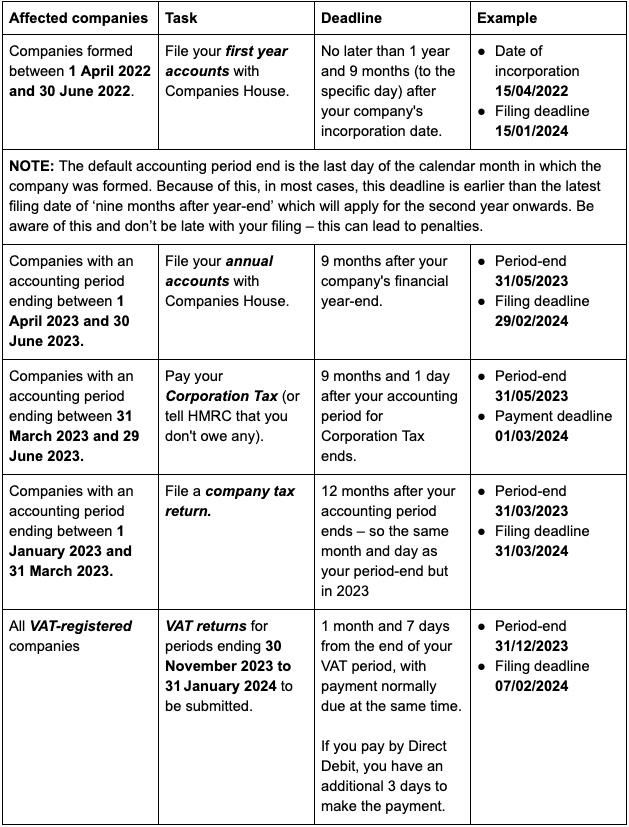
NOTE: If your company’s accounting period is longer than 12 months, the first tax payment deadline is normally 21 months and 1 day after your accounting period started, and the second one is 9 months and 1 day after your accounting period ends.

For example, a company with an accounting period running from 01/06/2022 to 30/09/2023 will pay the first tranche of corporation tax by 01/03/2024 and the balance by 01/07/2024

If your profits are more than £1.5 million, then tax is payable quarterly with two payments before the end of your accounting period and two after. The first payment is normally six months and 13 days after the start of the period, with the others three-monthly from that point.


Some general deadlines to plan for:

  • End of personal/payroll tax year: 5th April 2024, but practically speaking, for monthly payrolls the last one processed in the tax year is to 31 March 2024
  • Enterprise Management Incentives Scheme notice of options granted: within 92 days of grant
  • Final date to submit self-assessment tax return online for personal tax: 31 January 2024.
  • Make Capital Gains Tax payment for 2022/23 tax year: 31st January 2024 (60 days after completion for gains re residential property)
  • Make first payment on account for 2023/24 personal tax and balancing payment for 2022/23: 31st January 2024
  • PAYE and National Insurance Payments due: 19th calendar day of the month after end of month or quarter as applicable (22nd for electronic payments)

Talk to us about hitting your deadlines

Where we carry out the related activities (e.g. payroll processing), we’ll be monitoring your deadlines automatically – but don’t forget that you remain legally responsible.

Monitor your deadlines and check the upcoming dates for all relevant activities. Pay particular attention to those where we don't carry out the task for you. Failing to meet a compliance deadline can result in fines and penalties, so it’s good practice to keep everything on time.

Get in touch to discuss your deadlines.

By Anna Stubbs December 3, 2025
The latest edition of the Federation of Small Businesses’ (FSB) Small Business Index had some unexpected results when it comes to growth expectations of UK small businesses. 27% of businesses said they expected their business to shrink, close or sell up over the next year. This outweighed the 25% who predicted their business would expand over the same period. It’s the first time in the history of the SBI that expectations of contraction have outnumbered those of growth. And it underlines a growing trend.
By Anna Stubbs December 3, 2025
One of the best things about online shopping is instant, hassle-free payment. Enter your details, click, and you’re done. If your customers can make an instant online payment, they’re likely to pay you more quickly – and they’ll appreciate the simplicity too. The details Online payment methods include credit and debit cards, ACH (Automated Clearing House) services like Paypal, and repeat payments through direct debit. Payments are managed by merchant service providers – specialist companies that process transactions on your behalf. Some focus on credit and debit cards, while others stick to ACH or direct debit. Choose a provider that can integrate with your accounting software, and you can add a super-simple payment button to future invoices. The costs While your merchant service provider shouldn’t charge any set-up fees, they will charge transaction fees. These range from 2-4% of the invoice for debit or credit cards, and under $2 a transaction for direct debit. These fees are an added expense, so they need to be included in your profit calculation – smart accounting software will do this automatically. Because credit and debit fees can add up, many businesses don’t offer online payment for invoices over a certain amount. The benefits Businesses using online payments get paid faster. Of course, not every client will pay instantly just because they have the option, but it should speed up your average payment time.  A bonus benefit? Customers appreciate the ability to pay online, so offering it as an option can be a big point in your favour. Ready to reap the benefits of online payments? Get expert advice and set-up support from our accounting team.
By Anna Stubbs December 3, 2025
Starting, building and growing your own small business is a hugely rewarding experience for many entrepreneurs. But the road ahead isn't always smooth. There are common challenges that crop up and ongoing issues that need to be factored into your business plan, your strategy and your own personal thinking. So, what can you do to beat these challenges and make the journey as frictionless as possible?